Yep that works. thanks. I will now test how it works in our test environment.
Or if you can say what module contains it.
Where do I find this component? abp-personal-settings-verify-button I finally managed to try this solution and I don't find it anywhere.
So do you mean that I need to remove these parts from code an use Angular as static value here?
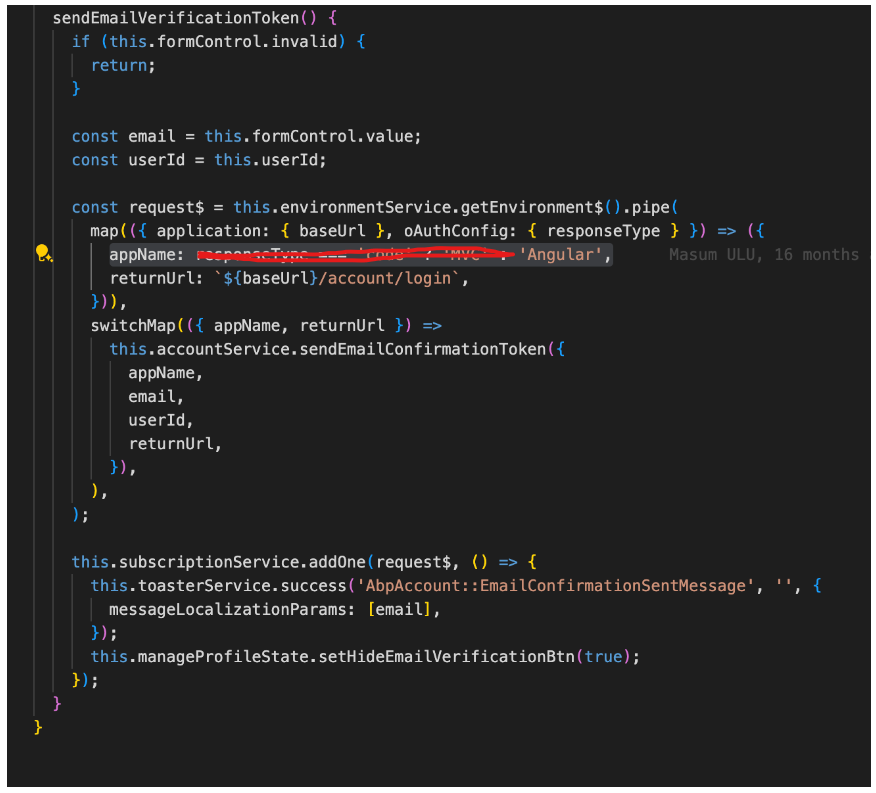
New page at new tab looks still just like any else page. And url is not auth server url. And when I click back to some else page from left navigation panel it goes there without any new tab opening. So is some auth server page integrated to angular page? If I look at generated html at F12 inspect view everything looks like angular page stuff with all those ng attributes and palceholders.
For me it looks like Angular.
{
    path: 'account',
    loadChildren: () => import('@volo/abp.ng.account/public').then(m => m.AccountPublicModule.forLazy()),
    canActivate: [authGuard],
  }
But for some reason it always open to new page when it is clicked. At menu provider there is this:
{
    id: eUserMenuItems.MyAccount,
    order: 100,
    textTemplate: {
      text: 'AbpAccount::MyAccount',
    },
    action: () => navigateToManageProfile(),
    visible: () => true
  }
navigateToManageProfile() values is from NAVIGATE_TO_MANAGE_PROFILE injection token which is not overrider by us. So it is as default value.
Now I have these configurations at ApiHostModule:
Configure<AppUrlOptions>(options =>
{
    options.Applications["MVC"].RootUrl = configuration["App:SelfUrl"];
    options.Applications["MVC"].Urls[AccountUrlNames.EmailConfirmation] = "account/email-confirmation";
    options.Applications["Angular"].RootUrl = configuration["App:AngularUrl"];
    options.Applications["Angular"].Urls[AccountUrlNames.PasswordReset] = "account/reset-password";
    options.Applications["Angular"].Urls[AccountUrlNames.EmailConfirmation] = "account/email-confirmation";
});
And these at AuthServer side.
Configure<AppUrlOptions>(options =>
{
    options.Applications["MVC"].RootUrl = configuration["App:SelfUrl"];
    options.RedirectAllowedUrls.AddRange(configuration["App:RedirectAllowedUrls"].Split(','));
});
After I added that MVC "account/email-confirmation", email configuration link started to work. Request is sent from application side so I assume that auth server configuration doesn't affect about link. So these configurations are working for us now, but do you still think there is something wrong with them? Because of cause I want to do how it should be done and at same time it should work properly.
That wasn't enough for email confirmation. I tested to change url from https://ourdomain.app/Account/EmailConfirmation?userId=sssss... to https://ourdomain.app/account/email-confirmation?userId=ssss... and it worked. So for me it seems that I will need this configuration as well.
options.Applications["MVC"].Urls[AccountUrlNames.EmailConfirmation] =
	"account/email-confirmation";
Remember that I'm using Angular frontend but this email-confirmation link is generated from here.
I found reason. I was logged in as another user when I clicked that link. So that is wokring now. Or was working all along. But how about that email confirmation?
Here is rest of it.
Culture=neutral, PublicKeyToken=7cec85d7bea7798e)
   at System.Runtime.CompilerServices.TaskAwaiter.HandleNonSuccessAndDebuggerNotification (System.Private.CoreLib, Version=8.0.0.0, Culture=neutral, PublicKeyToken=7cec85d7bea7798e)
   at Microsoft.AspNetCore.Mvc.RazorPages.Infrastructure.PageActionInvoker+<InvokeNextPageFilterAsync>d__31.MoveNext (Microsoft.AspNetCore.Mvc.RazorPages, Version=8.0.0.0, Culture=neutral, PublicKeyToken=adb9793829ddae60)
   at System.Runtime.ExceptionServices.ExceptionDispatchInfo.Throw (System.Private.CoreLib, Version=8.0.0.0, Culture=neutral, PublicKeyToken=7cec85d7bea7798e)
   at Microsoft.AspNetCore.Mvc.RazorPages.Infrastructure.PageActionInvoker.Rethrow (Microsoft.AspNetCore.Mvc.RazorPages, Version=8.0.0.0, Culture=neutral, PublicKeyToken=adb9793829ddae60)
   at Microsoft.AspNetCore.Mvc.RazorPages.Infrastructure.PageActionInvoker.Next (Microsoft.AspNetCore.Mvc.RazorPages, Version=8.0.0.0, Culture=neutral, PublicKeyToken=adb9793829ddae60)
   at Microsoft.AspNetCore.Mvc.RazorPages.Infrastructure.PageActionInvoker+<InvokeInnerFilterAsync>d__21.MoveNext (Microsoft.AspNetCore.Mvc.RazorPages, Version=8.0.0.0, Culture=neutral, PublicKeyToken=adb9793829ddae60)
   at System.Runtime.ExceptionServices.ExceptionDispatchInfo.Throw (System.Private.CoreLib, Version=8.0.0.0, Culture=neutral, PublicKeyToken=7cec85d7bea7798e)
   at System.Runtime.CompilerServices.TaskAwaiter.ThrowForNonSuccess (System.Private.CoreLib, Version=8.0.0.0, Culture=neutral, PublicKeyToken=7cec85d7bea7798e)
   at System.Runtime.CompilerServices.TaskAwaiter.HandleNonSuccessAndDebuggerNotification (System.Private.CoreLib, Version=8.0.0.0, Culture=neutral, PublicKeyToken=7cec85d7bea7798e)
   at Microsoft.AspNetCore.Mvc.Infrastructure.ResourceInvoker+<<InvokeNextExceptionFilterAsync>g__Awaited|26_0>d.MoveNext (Microsoft.AspNetCore.Mvc.Core, Version=8.0.0.0, Culture=neutral, PublicKeyToken=adb9793829ddae60)